







Brand Strategy For Small Business
Your customer is assembling one picture of you out of everything they see. Most small businesses hand them a new one every time.
Written by Paul Bosiger, Mission Beach Published Updated 8 min read
Brand strategy for small business comes down to one decision and one discipline. Decide the true thing your business stands for, then say it the same way, everywhere, for longer than feels comfortable. Your customer is assembling one picture of you from everything they see. A five-year study of 4,000 advertisements found that consistency compounds. The logo is the last layer, not the first.
- 01What A Brand Is When You Are Not In The Room
- 02Why Is Saying The Same Thing Not Boring?
- 03What A Story Does That A Claim Cannot
- 04What Is Brand Consistency Worth?
- 05Does Brand Trust Increase Sales?
- 06What Is Brand Strategy For A Small Business?
- 07How Does A Small Business Build A Brand Without A Big Budget?
What A Brand Is When You Are Not In The Room
A brand is the picture that assembles in a customer's head out of everything they have ever seen of you, most of it while you were somewhere else.
Not the logo. The logo is one thing they saw. So is the ute, the invoice, how the phone was answered, the brochure still in a rack at the visitor centre, the post your nephew wrote.
Nobody assembles that picture on purpose. They see a fragment, then another three weeks later, and their brain does the only thing it can with fragments, which is guess at the whole.
Every communication you send either adds to the same picture or starts a new one. Most small businesses start a new one every time, because each piece was made by a different person at a different time. The customer starts from scratch at every encounter, and never gets far enough to trust you.
Why Is Saying The Same Thing Not Boring?
You are sick of your own message long before your customer has noticed it.
You see your brand every day. Your customer sees it for four seconds, twice a year. What feels like repetition from the inside is, from the outside, the first time it registered.
Hence the business that rebrands every spring. New logo, new tagline, new colours, a post announcing an exciting new chapter. The owner feels refreshed. The customer, who had just worked out who they were, starts again.
It is the equivalent of changing your phone number because you were bored of it.
Consistency is not one advertisement run forever. It is the same position, the same idea and the same voice in a hundred different pieces, so each one is recognisably yours before the name is read. Hold still and each communication multiplies the last, so every dollar you spent earlier keeps paying. Rebrand out of boredom and you buy the same recognition again.
What A Story Does That A Claim Cannot
A claim invites an argument. A story a person is absorbed in moves their beliefs toward it, and the research on why runs from 2000 to a systematic review in 2024.
Tell someone your tours are the best on the coast and they start looking for the reason you are wrong. That is what a claim does. It puts the reader in the position of a judge.
Tell them instead what happened the morning the river came up, who made the call, and what the guests did with the afternoon, and they are in the story. Psychologists call it transportation. Green and Brock measured it in 2000: a transported reader's beliefs shift toward the story, with less of the counter-arguing a claim provokes. Escalas showed in 2007 that it holds where argument-based persuasion does not, and a 2024 review found the effect consistent across the literature.
What the research does not give is a percentage. Nobody has measured the lift of a story against a claim. Anyone quoting a conversion rate for storytelling made it up.
What Is Brand Consistency Worth?
The most consistent brands in a five-year study of 4,000 advertisements achieved 28% more very large business effects, and their advertising is expected to grow market share more than twice as effectively at the same spend.
The study is Compound Creativity, IPA and System1, October 2024. It scored 4,000 advertisements from 56 brands in 44 categories against the IPA Effectiveness Databank, 1,500 award entries over forty years, behind £3.3 billion of television spend.
The figures are in FIG. 1. The label: the United Kingdom, television-led, large advertisers. It is evidence that consistency compounds. It is not a promise that a tour operator at Mission Beach earns 28% more by tidying a logo.
What transfers is the direction. The most consistent brands got better creative every year, and the least consistent had to spend more to buy the same growth. The shape of it holds however far you scale it down.
The Consistency Ledger
4,000 advertisements, 56 brands, 44 categories, five years, £3.3 billion of UK television spend, scored against the IPA Effectiveness Databank.
Does Brand Trust Increase Sales?
Yes, at both ends of the sale: customers who trust a brand are 88% more likely to buy again from it, and four in ten have stopped buying from a company after trust was lost.
Consistency is how a brand gets believed. Trust is what that is worth, and two figures carry it.
Deloitte Digital, 2022: customers who trust a brand are 88% more likely to buy again from it. PwC, 2024: 46% say they bought more from companies they trust, 28% paid a premium to buy from one, and four in ten no longer buy from a company after losing trust in it.
What nobody has isolated is trust as a cause of clicks. Familiarity moves them, and familiarity comes from consistency, but no study separates the two. The measured chain runs from consistency to the picture, the picture to trust, and trust to the till.
What Is Brand Strategy For A Small Business?
What your business stands for and how it will say so, written down once, in four layers: what you stand for, the idea that carries it, how you sound, and only then how you look.
Ask most people what a consistent brand is and they will describe the surface. Same logo, same colours, same font. That is where consistency is easiest to see, and it is the least of it.
The study scored thirteen consistency features by depth. The foundations are a consistent positioning and a consistent creative idea, and brands must get those right before relying on consistency in anything else. Tone of voice, the slogan and the visual assets sit in the execution layer, which had been the whole conversation.
So the order of work is the reverse of the usual one. The true thing you stand for, in a sentence a customer could repeat. The one idea that carries it everywhere, from the highway sign to how you answer the phone. How you sound.
The logo comes last. That is the order the work gets done in here.
Under all four sits a layer nobody calls branding: the facts. Your name, what you do, where you are and how to reach you, identical on your site, your Google listing and every directory. It is the same rule that gets a business named by ChatGPT. A machine, like a customer, trusts what agrees with itself.
How Does A Small Business Build A Brand Without A Big Budget?
One document every communication comes out of, so the next brochure, the next ad and the next person you hire all start from the same place.
The brands in the study had agencies and five-year budgets. Underneath, they were paying for one decision held steady long enough to compound, and that part is free. That base is what turns consistency into multiplication: each communication builds on the one before instead of starting again. It costs only the discipline of writing it down once and not redeciding it whenever somebody new picks up the work.
Write the four layers in order. What you stand for, in one sentence. The idea that carries it. How you sound, with real examples.
How you look, with the exact colours and the rules for the logo. Then hand it to everyone who makes anything for the business, including you at ten at night with a post to write.
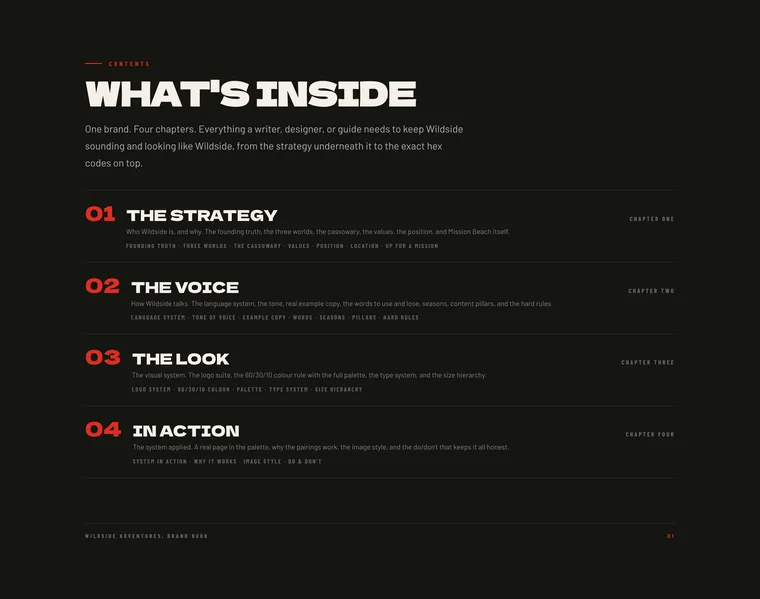
That is what a brand book is. Wildside Adventures, a tour operator at Mission Beach in Far North Queensland, got one with four chapters, and every surface since has come out of it. Open the case study and watch how little the picture changes.
Ours is called the Brand Guide: the four layers, in that order, aimed by the research that goes into it. Say the same true thing, the same way, long enough that people can finish it for you.
01How do you do brand strategy?
Write it down in order: what you stand for in one sentence, the idea that carries it, how you sound with real examples, and how you look. Then hand it to everyone who makes anything for the business, so every communication comes out of the same place.
02Why does brand consistency matter?
Because your customer is assembling one picture of you out of everything they see, and each communication either adds to it or starts a new one. The IPA and System1 found the most consistent brands achieved 28% more very large business effects over five years.
03Do I need a brand strategy before a logo?
Yes. A logo is a decision about how you look, and it cannot be made well before you have decided what you stand for and how you sound. Designed first, it gets redesigned.
04Does branding increase sales?
Trust does, at both ends. Deloitte Digital, 2022: customers who trust a brand are 88% more likely to buy again from it. PwC, 2024: four in ten have stopped buying from a company after trust was lost. Nothing credible isolates branding as a cause of clicks.
05What are the signs of a weak brand in a small business?
Put your website, brochure, social page and signage side by side. If a stranger could take them for four businesses, your customer is working out who you are from scratch at every encounter.
What This Is Built On
- The serviceHow the work gets done, foundation up→
- The proofWildside Adventures, the rebrand and its book→
- The groundMarketing in Far North Queensland→
- The next stepThe Brand Guide, $1,500, two weeks→
Written by Paul BosigerYKC AgencyMission Beach№ 0002