







Brand Storytelling For Small Business Growth
Storytelling is the best way to connect with your audience and be remembered. A story is the mechanic to wrap your brand into a message people remember, delivered in a way they feel.
Written by Paul Bosiger, Mission Beach Published Updated 8 min read
Brand storytelling for small business growth is the best way to connect with your audience and be remembered. A story is the mechanic that wraps what you stand for into a message people remember, delivered so it is felt, and the creative work decides whether it travels. The evidence is counted below, and one estate at Mission Beach shows two stories doing two different jobs.
- 01Why Is A True Message Not Enough?
- 02Why Do People Remember A Story And Not A Fact?
- 03What Is Creativity Worth In Marketing?
- 04What One True Story Did For An Estate At Mission Beach
- 05Where Does The Story Run Through A Brand?
Why Is A True Message Not Enough?
A customer keeps what they felt, not what they were told, so a true line nobody feels is the expensive one.
Family owned. Twenty years of experience. Quality you can trust. All of it true, all of it on every second website on the coast, and none of it has ever been repeated by a customer to a friend.
Attention is cheap and trust is not. The line that costs a business most is not the one that gets argued with. It is the one that gets read, believed and forgotten inside a minute, because it asked nothing of the reader and gave them nothing to hold.
Creativity is the difference between the two. Not louder, not cleverer. The craft of wrapping what you stand for in the one true thing specific enough to be felt, and having the confidence to lead with it.
Why Do People Remember A Story And Not A Fact?
A story carries the reader inside it, and a reader inside a story stops arguing with it.
Psychologists call it transportation, and the research on it runs from Green and Brock in 2000 to a systematic review in 2024. The mechanism is in the piece before this one. The part that piece did not cover is the catch: it only works if the story is good enough to carry someone.
A story is built, not found. Under it sits the message, the one thing the business stands for. On top of that sits the idea: the creative vehicle that carries the message somewhere a claim cannot go, an image, a line, a way of seeing the place that belongs to nobody else.
Then the shape, which is older than marketing. Something is at stake. Something turns. The ending is left for the reader to finish, and finishing it is how they come to feel it was theirs.
That is why a story is kept and a fact is not. A fact asks to be filed. A story asks to be completed, and a person remembers what they took part in.
The emotional connection everyone talks about is not a mood laid over the message. It is the recognition a reader feels when they find themselves inside the idea. Nobody has put a credible percentage on it, and the people quoting one made it up.
What Is Creativity Worth In Marketing?
Campaigns built on emotion report very large profit effects almost twice as often as rational ones, and the most creative advertising earns more than four times the profit of the rest.
Four measurements carry it, and they are in FIG. 1 with their labels. Binet and Field read the IPA Effectiveness Databank in 2013 and found 43% of emotional campaigns reporting very large profit effects against 23% of rational ones, over three years and longer.
Kantar and WARC, 2023: the most creative and effective ads generate more than four times as much profit. NCSolutions, 2023: 49% of an ad's incremental sales come down to the creative, across about 450 campaigns. Nielsen, 2016: a 23% sales lift for ads with an above-average emotional response.
Read the labels before the numbers. Large advertisers, television and packaged goods, the United Kingdom and the United States. None of it is a promise about a builder at Tully. What transfers is the shape: the work is not decoration on the message, it is most of what the message earns.
The Creativity Ledger
What the creative work itself has been measured to earn, on large advertisers, television and packaged goods.
What One True Story Did For An Estate At Mission Beach
It put a council approval into the brand's identity, which most estates keep in a folder, and the approval message drew the conversation while the freedom message carried the reach.
Headland is twelve homesites on a private headland at South Mission Beach, with one approval from Cassowary Coast Regional Council behind them and a paper trail running from 2007 to 2022. The buyer's fear, found in the research, was operational: two years and seven figures spent before discovering the approval would not allow the home they wanted.
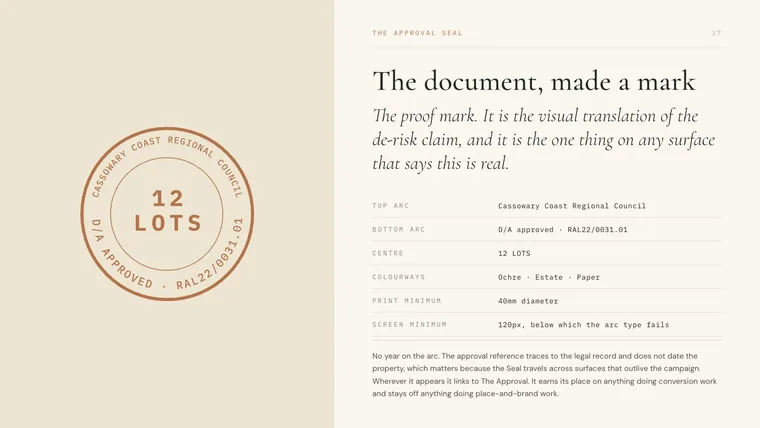
So the approval became the story. Not a line about it, the document itself, drawn as a seal and put on every asset, with the reference number on it. A second story ran beside it, the one the approval buys: the freedom to build however you please.
Two true stories, two jobs. The approval message drew the conversation: 23 comments against 9, and 50 saves against 33, campaign to date.
It also drew scrutiny. The region's mayor commented publicly on a post, and the reply came straight from the stamped approval, in front of the same audience that saw the question asked. The freedom message did the other job: by day 29 its reel had been played 12,010 times against the approval film's 9,541, and it is the one that gets shared on.
The outcome sits on the case study with its window, the quarter from 10 July to 9 October 2026: leads at $19.71 each against a forecast of $60 to $90.
Where Does The Story Run Through A Brand?
Through all four layers, so that a customer who meets you on a sign, a post and a phone call knows they are inside the same book.
The last piece set out the four layers in order: what you stand for, the idea that carries it, how you sound, how you look. Storytelling is not one of those layers. It runs through all of them.
The proposition is the story at its shortest. The idea is the story with a shape. The voice and the look are the same story told on every surface, and when they agree, the customer never has to work out whether this is the same business.
At Headland the story was decided once and written into the brand book: the approval is the story. The seal, the master line, the reel and the way a comment gets answered all came out of that one decision, so nothing had to be decided again when a new surface came along.
That is the case for building a brand with one agency, foundation up, rather than across several. The story is set with intent at the foundation and carried through every layer by the same people, so the communications stay coherent and nothing is lost in a handover. The efficiency comes from the same place: work decided once and kept in one hand. That is the order the work gets done in here.
Setting the story at the foundation, with intent, is what the Brand Guide is for. A true story, told with confidence, will resonate and deliver scalable results.
01What does brand storytelling mean?
Wrapping what a business stands for into a message a customer remembers, delivered in a way they feel rather than argue with. It is the idea layer of a brand, under the proposition and above how it sounds and looks.
02Why is brand storytelling important for a small business?
Because a customer keeps what they felt, not what they were told. A true line nobody feels is read, believed and forgotten, and a small business cannot afford to be forgotten by the few people who found it.
03Does emotional advertising work?
In the largest reads of it, yes. Binet and Field found 43% of emotional campaigns reporting very large profit effects against 23% of rational ones, and Nielsen measured a 23% sales lift for ads with an above-average emotional response. Both were measured on large advertisers, so the direction transfers and the number does not.
04What is a brand story and why does a small business need one?
The proposition wrapped into a message people remember and repeat, decided once and held everywhere. A small business needs one because its customers assemble a picture of it from fragments, and a story is the fragment they keep.
05How do I find my business story?
Set it once, at the foundation, with intent: what the business stands for, wrapped in an idea people remember. Then carry that one story through every communication so a customer meets the same brand on every surface. A brand guide is where that decision is written down. Say it out loud to a customer and watch whether they lean in.
What This Is Built On
- The serviceHow the work gets done, foundation up→
- The proofHeadland Mission Beach, two stories and one approval→
- The groundMarketing in Far North Queensland→
- The next stepThe Brand Guide, $1,500, two weeks→
Written by Paul BosigerYKC AgencyMission Beach№ 0003