

How To Market A Resort In Tropical Australia
Every resort on this coast sells the same reef and the same rainforest. The one that tells the place as its own is the one remembered when the rooms get compared.
Written by Paul Bosiger, Mission Beach Published Updated 8 min read
To market a resort in tropical Australia, sell the place before the rooms. Nobody searches for a resort they have never heard of. They search for Mission Beach, the reef, the rainforest. Name the place the way they type it, and answer them on your own site. One new resort here went from 61 followers to 380 in five weeks, without a dollar of ads.
- 01How Do I Market A Resort In Australia?
- 02Why Is A Resort Booked Sight Unseen?
- 03What Do You Sell First, The Place Or The Rooms?
- 04Does A Resort Still Need Its Own Website?
- 05How Does A New Resort Grow An Audience With No Paid Spend?
- 06What Does A Resort Sell When The Rooms Are Quiet?
How Do I Market A Resort In Australia?
Sell the place first, then prove the stay, then take the booking on ground you own, because that is the order a traveller looks in.
Every resort on this coast sells the same reef and the same rainforest, to someone a long way off who has already read about everywhere else. The place is the whole advantage, if it is told first and told as yours.
So the job runs in the order a traveller does it. They start with where they want to be, then look for proof that a stay there is what the pictures promise, then look for the cheapest safe way to book it. A resort that answers in that order is found, believed and booked. One that opens on room rates is compared on room rates.
Why Is A Resort Booked Sight Unseen?
Because nobody can visit before they pay, so the case is made entirely from what they can find, and they find a great deal of it.
Expedia Group put the window from the first idea of a trip to the booking at 71 days, in 2023, with 141 pages of travel content read in the final 45 of them. Tripadvisor and Ipsos MORI found 81% of travellers always or frequently read reviews before booking a place to stay, and 72% before deciding where to stay, eat and what to do.
Read the labels. Both are global reads from the platforms' own research, not a Queensland survey. The shape is what transfers: a stay is decided over weeks, on pages, before anyone rings.
So marketing a resort is everything a stranger can find about it, assembled into a case in the weeks they are quietly reading, and built to the standard of the stay. The site, the listing, the reviews and the replies to them, the feed, the map pin, the photograph someone else took. All of it is the brochure now, and most of it was never written as one.
What Do You Sell First, The Place Or The Rooms?
The place, because nobody searches for a resort they have never heard of, and everybody searches for where they want to be.
The traveller's first search is a place name. Mission Beach, Port Douglas, the Daintree, the reef. A resort nobody has heard of does not appear in that search unless it has made itself part of the answer, and the resort that has is the one they meet before the rooms are ever compared.
So the place goes first, in the words people use for it. Not the brochure's words. The ones typed into a search box and said at a dinner table: reef and rainforest, quiet, adults only, the far north.
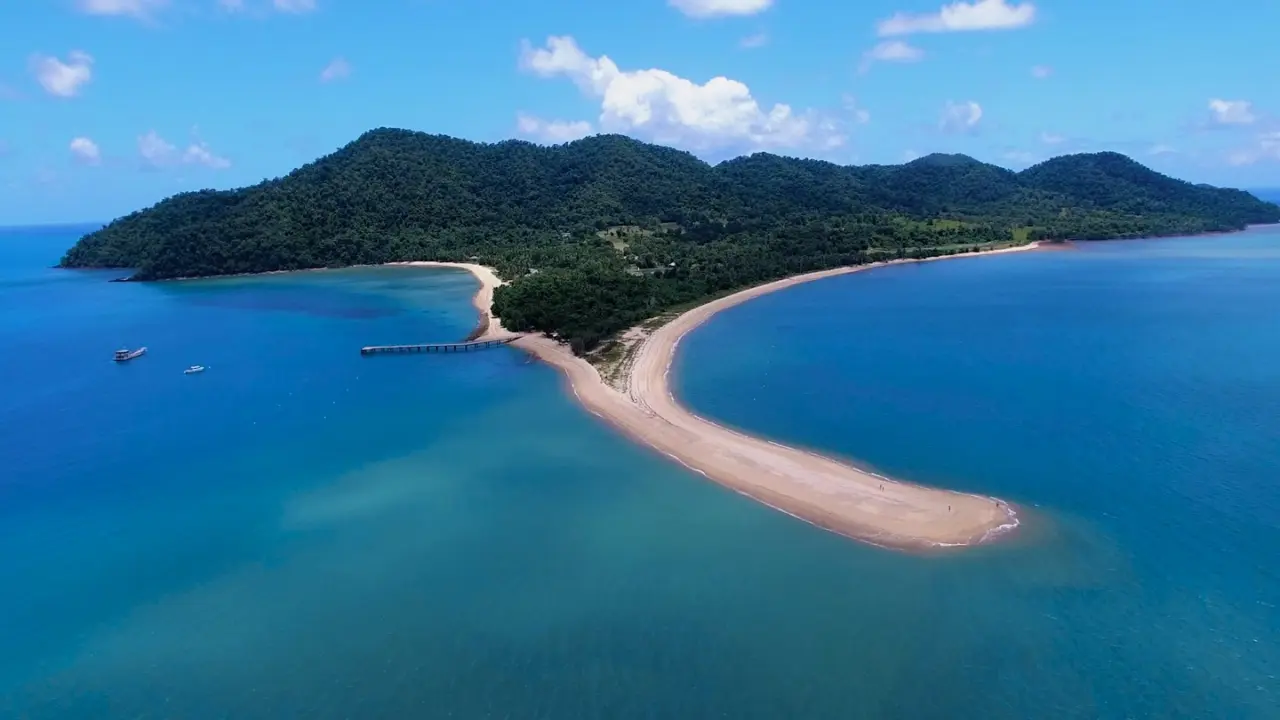
A caption from the resort in the count below reads between reef and rainforest, on a quieter stretch of Tropical North Queensland. That is a place before it is a room, and it is the line strangers stopped on.
The place is the one thing the resort up the road cannot copy, once it is told as this headland, this creek, this stretch of beach. The rooms come after, as proof that the stay lives up to it.
The mechanics are plain. The place is named on the page a search engine reads first, in the caption a stranger scrolls past, in the reply to a review and in the answer a resort gives when someone asks an AI what is near the reef. Same place, same words, every surface. The piece before this one covers why a line said the same way is the one that gets kept.
Does A Resort Still Need Its Own Website?
Yes. The platforms buy reach, and the resort's own site is where that reach becomes a booking that keeps its margin.
The online travel sites put a resort in front of people who would never have found it, and every resort on the coast lists on them for that reason. What they cannot do is tell the place, show the table or answer the question a stranger has at eleven at night.
The site has four jobs. Answer the real searches, place first. Load fast on a phone, because that is where a holiday is read.
Put the direct path to a booking first and make it the easiest one. Say what the listing cannot: the table, the season, who runs it.
Since 1 September 2016 the two largest platforms in Australia have not been allowed to require the lowest rate or the last room. The ACCC recorded that Expedia, including Wotif, and Booking.com removed the clauses that made Australian accommodation providers match any other site's rate and their own offline channels, and hand over all remaining rooms. A resort can offer a better rate by phone, to walk-ins and to its own loyal guests. Most still price as if it could not.
The shape of a site doing its job is on this coast. Wildside Adventures is a tour operator rather than a resort, and the mechanism is the same: every page rebuilt to answer a real search, the direct booking path put first, no ad spend. Clicks a month went from a two-year ceiling of 350 to 1,020, and 44% of them come from people who never typed the name.
How Does A New Resort Grow An Audience With No Paid Spend?
Turn what the resort stands for into a handful of pillars, the pillars into a calendar, and post from day one.
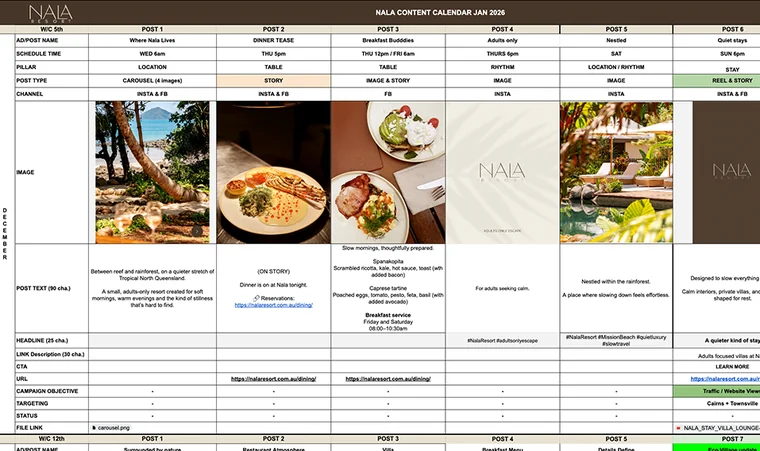
Nala Resort opened at Mission Beach over Christmas and New Year with the brand built and no digital presence beyond a website. Festive bookings, seasonal menus and hours that moved with the season all had to reach people fast, in the wet, from an Instagram account with 61 followers.
The method was one decision made once. The brand's values became five pillars: location, stay, table, rhythm, trust. The pillars became a calendar, with a post type and a channel against each day. The practical went out from day one, hours and menus and bookings, while the shoot was planned and the first films were cut, so the feed was live while it was still being made.
Five weeks later the account had 380 followers, from 61. Content reached 189% of the following. Facebook views came to 114.5K in the same five weeks. No boost, no spend, 26 assets, one calendar.
The count is in FIG. 3 with its window.
For a resort that is not new, the lesson is the same: the calendar is the work, and the pillars are the resort's own values written down. A feed decided in advance tells the place, the stay and the table in turn.
The Nala Ledger
What five weeks of organic content did for a five-star opening at Mission Beach, measured against the account that existed before it.
What Does A Resort Sell When The Rooms Are Quiet?
The door people assume is shut: the table, the pool, the season, said plainly to strangers.
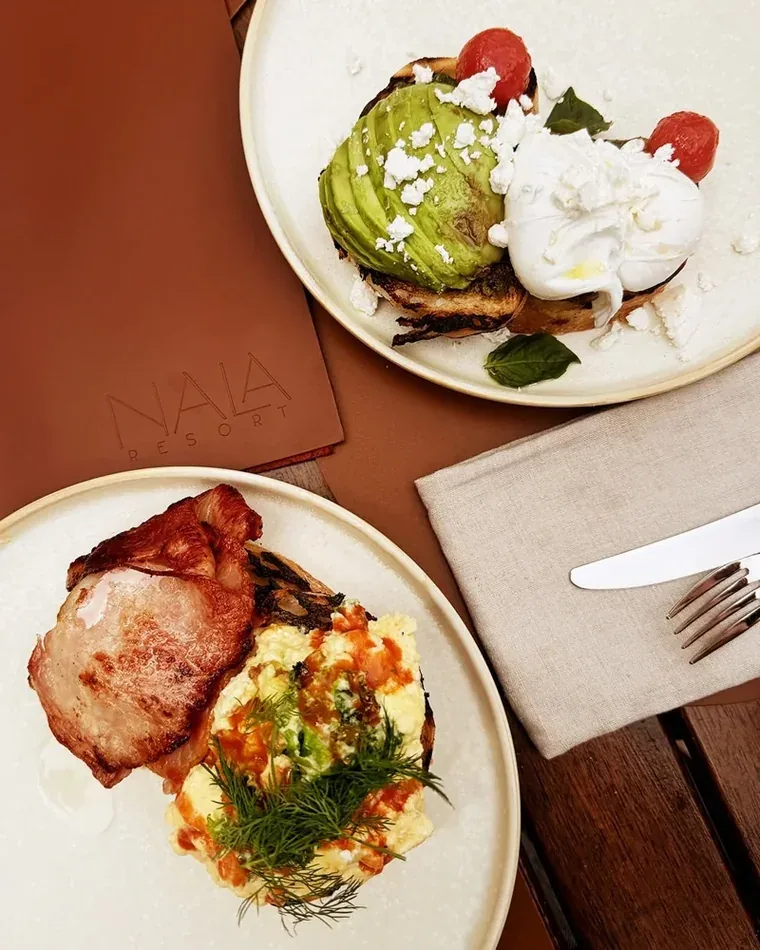
Nala's restaurant was open to the public for dinner and for weekend brunch. Most people on the coast assumed a resort restaurant was for guests, so they never thought to book a table. One message, said plainly in the feed: you can book the table without booking a room.
No spend went behind it. One carousel, posted and left to run, was viewed 12,919 times and reached 8,205 people, 90.7% of whom did not follow the page. A resort had found a second door and a second audience, in the same town, in the wet.
Every resort has one: the pool on a hot Sunday, the long lunch, the room in the season everyone else calls off. Rain on a rainforest is the story a southern winter cannot offer, and the resort that says so out loud sells nights the calendar had written off.
The order holds at every door. The place, then the proof, then the booking on ground the resort owns. Sell the place, and the rooms follow.
Before a dollar goes to reach, look at what a stranger finds. That is what the Visibility Audit measures.
01How do I promote a resort?
Place first. Name where the resort is in the words people search for, on the site, in the feed and in every reply to a review. Then prove the stay with real pictures and real words, and make the direct booking the easiest path. Promotion that skips the place sells a room rate against every other room rate.
02How do small tourism operators market themselves?
With what they own. A site written to the searches people already make, a feed decided in advance rather than posted when someone remembers, and reviews answered by name. Wildside Adventures at Mission Beach went from 350 to 1,020 clicks a month that way, with no ad spend.
03How much should a tourism business spend on marketing?
There is no credible published figure for a small Australian resort, and anyone quoting one is selling something. Spend follows measurement. Look at what a stranger finds when they search the place and the resort, fix what is missing on ground you own, and put money behind reach only once the site and the feed can convert it.
04How do I advertise my hotel?
Not first. Advertising buys attention for a specific offer and it shows in days, so it works once the place is told, the site converts and the offer is real. Run it before that and the money buys visits to a page that sends people back to the platforms.
What This Is Built On
- The serviceTourism and resort marketing, booked not just seen→
- The proofNala Resort, 61 to 380 followers in five weeks→
- The groundMarketing in Far North Queensland→
- The next stepThe Visibility Audit, $500, one week→
Written by Paul BosigerYKC AgencyMission Beach№ 0004